
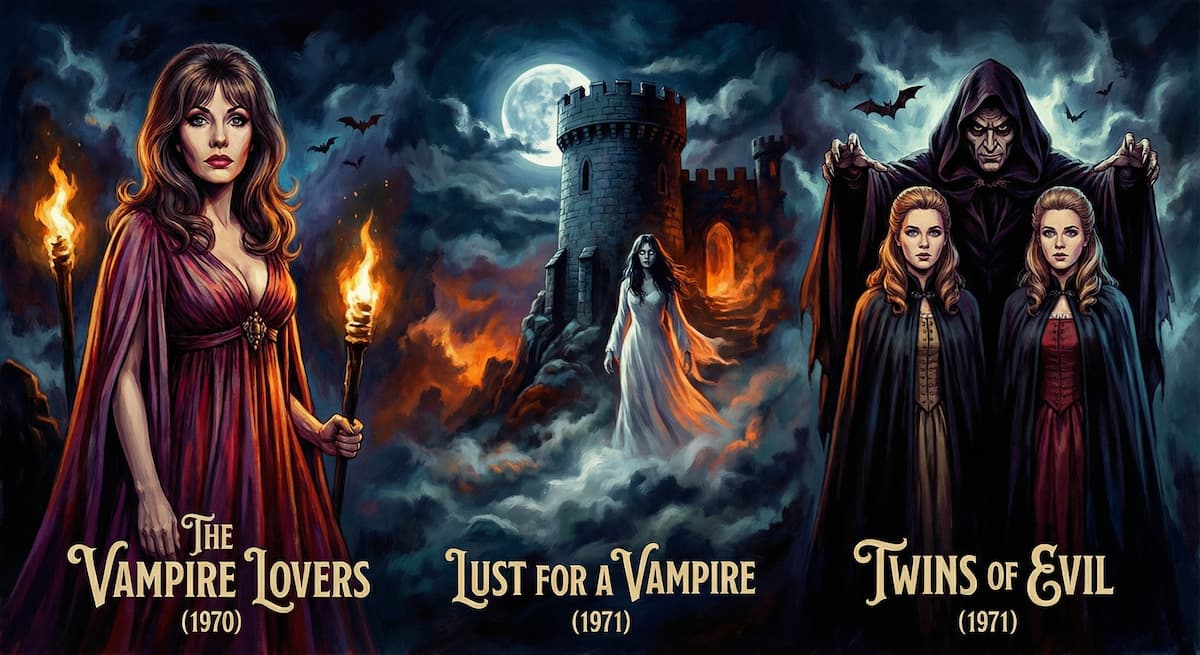
Hammer Films didn’t just make vampire movies—they served them like a lavish dessert tray: ornate, colorful, and faintly dangerous. In a tight burst of production and release (the UK releases landed within roughly a year), Hammer delivered three loosely linked films inspired by Sheridan Le Fanu’s 1872 novella Carmilla—today grouped as The Karnstein Trilogy: The Vampire Lovers (1970), Lust for a Vampire (1971), and Twins of Evil (1971).
They aren’t a neat chapter-by-chapter storyline. Think of them more like three variations on a theme: a cursed aristocratic bloodline, a haunted corner of “Styria,” and a recurring vampire identity that keeps changing names (Carmilla/Mircalla/Marcilla) like she’s dodging process servers.
What makes the trilogy such a cult favorite is the Hammer recipe: gothic sets, torchlit forests, vintage glamour, and a frankness (for the time) about erotic charge—especially in The Vampire Lovers and Lust for a Vampire.
1) The Vampire Lovers (1970): The Crown Jewel (and the most “Carmilla” of the three)
If you only watch one, many fans start here: The Vampire Lovers is the closest to Le Fanu’s Carmilla in structure and mood, and it introduced a Hammer icon performance from Ingrid Pitt as Carmilla/Mircalla/Marcilla.
Notable cast
- Ingrid Pitt — Carmilla/Mircalla (the trilogy’s defining vampire presence)
- Peter Cushing — General von Spielsdorf (stern gravitas + stake-ready authority)
- Kate O'Mara — The Governess. Note: She also had a role in Hammer's "The Horror of Frankenstein" (1970).
- Also featured: Madeline Smith, George Cole, Douglas Wilmer, Dawn Addams
Fun (and extremely Hammer) trivia
During a scene where Carmilla attacks a character played by Kate O’Mara, Ingrid Pitt’s vampire fangs reportedly kept popping loose—at one point dropping into O’Mara’s cleavage—until Pitt improvised a fix using chewing gum from a crew member. That’s gothic professionalism.
Filming locations you can actually visit
Hammer’s “Styria” is largely Hertfordshire in a fabulous disguise:
- Moor Park Mansion / Moor Park Golf Club (Hertfordshire) — used as von Spielsdorf’s palatial home
- Wall Hall (Aldenham, Hertfordshire) — used as Roger Morton’s mansion
- Elstree Studios are also associated with production for this period (and show up in Hammer location listings)
Vibe check: This film is all candlelit interiors, swooning victims, and that particular Hammer blend of elegance and lurid shock.
2) Lust for a Vampire (1971): Boarding School Bloodlust (and peak early-70s weirdness)
Lust for a Vampire veers into “gothic pulp” territory—in a good way if you like Hammer at its most unbothered. The hook: a finishing school setting, a resurrected Karnstein vampiress, and a soundtrack/atmosphere that feels like it’s flirting with a delirious fever dream. It’s also known by alternate titles including To Love a Vampire (US TV title).
Notable cast
- Yutte Stensgaard — Mircalla/Carmilla
- Ralph Bates — Giles Barton (Hammer regular; effortlessly watchable)
- Suzanna Leigh, Barbara Jefford, Michael Johnson
Filming locations (this one is a treat for location nerds)
Reelstreets documents the production using locations in Hertfordshire and Carinthia, Austria, including a standout castle shot:
• Hunton Park (Hertfordshire) — used for the finishing school exteriors and grounds; it’s also identified as the front entrance and gardens in multiple scenes 
• Hochosterwitz Castle (Carinthia, Austria) — appears as “Karnstein Castle” (and yes, the approach is guarded by multiple fortified gates—practically a production designer’s gift)
• Reelstreets also notes studio-tank work tied to EMI-MGM studios in Borehamwood for waterside scenes
Vibe check: If The Vampire Lovers is the “best adaptation,” Lust is the “midnight movie cousin” who shows up in velvet and insists everyone try the mystery punch.
3) Twins of Evil (1971): Witchfinders vs. Vampires (and Peter Cushing at full power)
Twins of Evil is often singled out as the most dramatically satisfying of the three—less “seduction plot,” more moral panic, fanaticism, and folk-horror energy. It folds in a witch-hunting “Brotherhood” led by Peter Cushing, while Count Karnstein’s evil resurfaces in bloody fashion. It’s also known as Twins of Dracula.
Notable cast
- Peter Cushing — Gustav Weil, a puritanical leader of the witch-hunting Brotherhood
- Madeleine Collinson & Mary Collinson — real-life identical twins as Frieda and Maria
- Dennis Price, Kathleen Byron, Damien Thomas, David Warbeck
Extra bit of poignancy: Wikipedia notes this was the Collinson sisters’ final acting work.
Production notes & “where was it shot?”
This film leans hard into forests, mists, and that “somewhere in Central Europe” look—created in very practical UK ways:
- Black Park Country Park (Wexham, Buckinghamshire) — a classic Hammer outdoor location
- Pinewood Studios (Iver Heath, Buckinghamshire) — studio work
- Centralni Filmski Studio Košutnjak (Belgrade, Serbia) is listed among production studio facilities
And for context: Black Park sits right by Pinewood and was used constantly as “Transylvania-by-proxy” in Hammer’s era.
Vibe check: This is the trilogy entry for people who like their gothic horror with a side of righteous terror and “who’s actually the monster here?” tension.
The trilogy’s secret ingredient: the places
Part of why these films endure is that Hammer understood something very simple: a good mansion and a good forest do half the work for you.
If you ever find yourself planning a UK film-nerd day trip, you could practically build a “Karnstein crawl” around:
- Moor Park + Wall Hall (for The Vampire Lovers)
- Hunton Park (for Lust for a Vampire)
- Black Park (for Twins of Evil, and about a hundred other productions)
And if you’re ever in Austria and want to live your most dramatic gothic life for an afternoon, Hochosterwitz Castle is one of those “how is this real?” locations that looks pre-lit for a Hammer title sequence.
If you’re watching in order: what to expect
- Start with The Vampire Lovers if you want the strongest “Carmilla core” and the most iconic Karnstein vibe.
- Go to Lust for a Vampire if you want the strangest, campiest, most “Hammer doing Hammer things” middle chapter.
- Finish with Twins of Evil if you want the biggest tonal swing—more moral severity, more stakes (literal and ethical), and a terrific Cushing showcase.
A closing toast (preferably from a silver goblet)
Hammer’s Karnstein Trilogy is a tiny mini-era all its own: the studio leaning into gothic eroticism, lush color, and a knowing wink at what audiences wanted in the early 1970s—while still giving you foggy forests, candlelit corridors, and the satisfying certainty that someone will eventually run screaming through the woods.
If you’ve never seen them, they’re worth it for the faces (Pitt! Cushing!), the fashion, and the way Hammer turns perfectly ordinary English locations into “haunted Central Europe” with sheer confidence.