
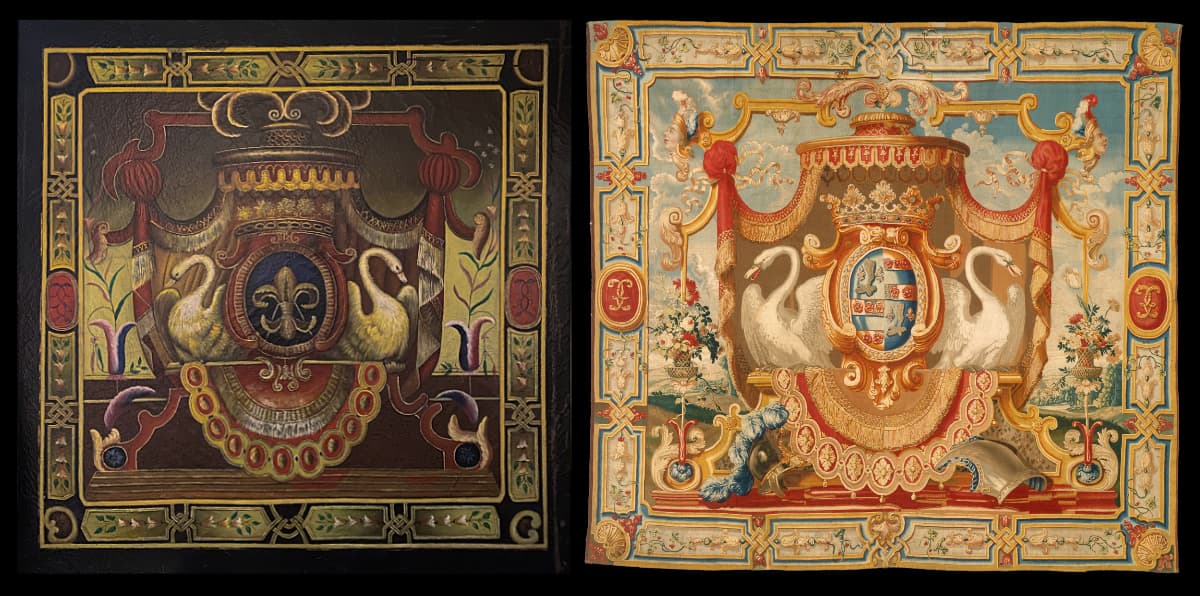
Not all antique finds come with provenance paperwork. Sometimes what draws us to a piece is mystery — and beauty. That was certainly the case when I stumbled upon a richly detailed heraldic painting at an antique shop in Charlotte, NC. At first glance its decorative swans, elaborate canopy, and central crest hinted at deeper meaning — and a little research confirmed it: this painting appears to have been inspired by a 17th-century armorial tapestry now in the collection of the Metropolitan Museum of Art in New York.
Inititally, I thought this painting might have been something created for a restaurant or pub. While I still don't know why it was created (or who created it), I now know what inspired it thanks to google image search. Google image search quickly matched it up with the Arms of the Greder Family of Solothurn, Switzerland tapestry.
The Tapestry: Arms of the Greder Family of Solothurn, Switzerland
The following information is from the Metropolitan Museum of Art, New York:
The tapestry, titled Arms of the Greder Family of Solothurn, Switzerland, was woven around 1691–1694, likely in Paris or the Lorraine region of France.
This large textile — over nine feet wide — was commissioned by François Laurent Greder (1658–1716), a native of Solothurn whose family produced several officers in the French army. Historical records suggest he had this tapestry made after rising to the rank of brigadier in 1691 and before being named a knight of the Order of Saint Louis in 1694.
At the center of the composition sits the Greder coat of arms, flanked by two white swans — a symbolic reference to the family crest itself (the Greder arms reportedly include swan feet). Surrounding the coat of arms is an ornate canopy, lush drapery, and elaborate floral borders typical of late-17th-century French tapestry design.
The tapestry was woven in two pieces and then sewn together — a clue that its production workshop may have been smaller than France’s major tapestry manufactories such as Gobelins or Beauvais.
What Is an Armorial Tapestry?
Before modern print or digital media, tapestries communicated status and identity in a way that today’s social platforms try to emulate. They were visual announcements of prestige — elaborate, portable, and often displayed in public or ceremonial spaces. Armorial tapestries specifically wove a family’s coat of arms into luxurious wool, silk, and metal threads to celebrate lineage, allegiance, and accomplishments. Source: The Metropolitan Museum of Art, New York.
In effect, an armorial tapestry could serve a function not unlike a noble’s social media profile — a grand statement of who they were and what they had achieved.
A Painting Inspired by a Tapestry
The painting I acquired echoes much of the tapestry’s visual grammar:
• Symmetrical composition
• Heraldic shield at center
• Swans as symbolic supporters
• Ornate drapery and canopy
• Decorative Border Elements
While not an exact copy, this painting clearly channels the armorial style and heraldic motifs of the original tapestry. This kind of artistic reinterpretation may have been created as a decorative homage — possibly for a collector enamored with Swiss or French heraldry — or as a commissioned work for a client connected to the Greder lineage or simply inspired by the tapestry’s design.
Additionally, the painting measures 4 feet by 4 feet whereas the original tapestry measures 8.9 feet by 9.5 feet -- quite a reduction in size.
Heraldry, Power and Patronage
The tapestry’s origin with François Laurent Greder links it to the military and social worlds of late-17th-century Europe — a time when Swiss families often served as officers in foreign armies, and when owning richly woven tapestries was a clear demonstration of wealth and influence.
Final Thoughts
Whether this painting is a workshop replica, a later 18th- or 19th-century reinterpretation, or simply an inspired homage, it carries forward a design language rooted in aristocratic display and textile artistry. I enjoy looking at it every day.