
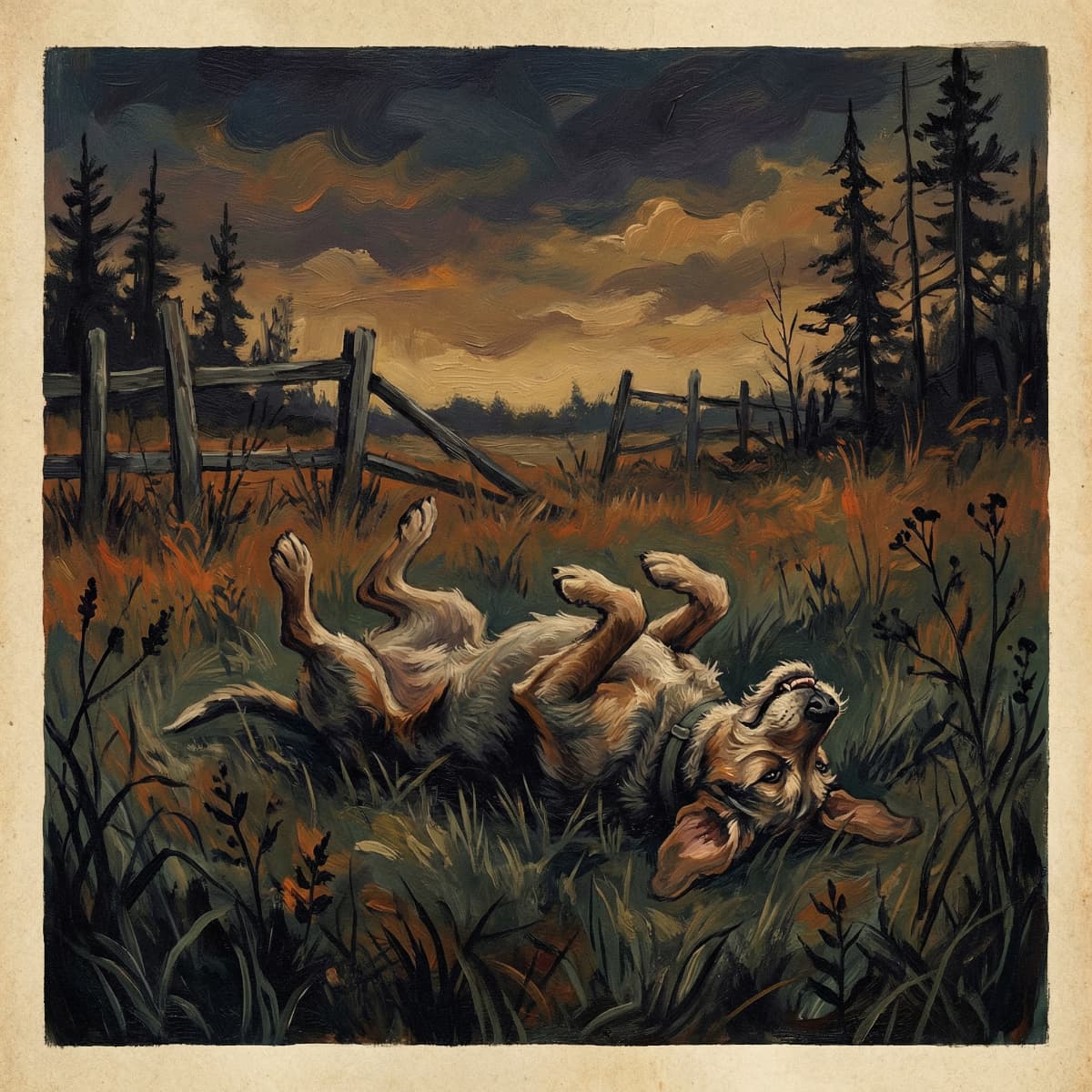
There are words that live only in the mouths of the old — passed from porch to porch, from grandmother to grandchild, never written down, never looked up. Ch'yarn is one of them.
Growing up in Laurel, Mississippi, I heard the word regularly. You'd say it when the dog came loping back across the yard with that particular guilty swagger and a smell that hit you like a wall: "Lord, he's been wallerin' in some ch'yarn." Everyone knew exactly what you meant — something dead and rotting, unseen in the tall grass, that the dog had found and joyfully rolled himself in. The word carried not just a meaning but a texture, a wrinkle of the nose, a knowing groan.
I never knew how to spell it. When I asked the people who used it, neither did they.
The Word That Traveled
Years later, in my thirties, I met a friend who grew up in Baxley, Georgia — nearly five hundred miles from Laurel. One day, in the middle of a conversation, I used the word. She didn't miss a beat. She knew it immediately, in the same sense, with the same wrinkled nose.
That moment lodged in my memory. A word that neither of us could spell, that neither of us had ever seen written, that we had both absorbed from the older generation — and it had traveled across two states without losing an ounce of its meaning.
Where Did It Come From?
The most likely origin is carrion — the standard English word for dead, decaying flesh. Say it fast, compress it the way Deep South rural speech tends to compress things, let the hard c soften toward a ch sound, drop the middle syllable, and you get something remarkably close to ch'yarn or ch'yon.
This kind of phonological drift is completely normal in oral language. Words get reshaped through generations of being spoken rather than written — clipped, elided, softened or sharpened — until they wear the accent of the people who carry them. Think of how I am going to becomes I'mna, or fixing to becomes fixin' to. Spoken language breathes and shifts; written language holds still.
What makes ch'yarn especially interesting is its geography. Laurel and Baxley both sit within a very specific cultural corridor: the piney woods and wiregrass belt that runs from eastern Mississippi through south Georgia. This region shares a common heritage — predominantly Scots-Irish settlers who moved westward in the eighteenth and nineteenth centuries, bringing their words with them. It is a zone with its own sub-dialect, distinct even from other parts of the South, shaped by relative isolation from urban influence well into the twentieth century.
The fact that the word survived, in the same form and meaning, across that whole corridor strongly suggests it was once widely used throughout this region — not a family quirk, not a mishearing, but a living piece of the local tongue.
Scots-Irish in Amber
There is another possibility worth considering. The Scots-Irish settlers who populated this belt brought vocabulary from Gaelic, Scots, and archaic Ulster English. Some of those words survived in the American South long after they had died out in their countries of origin — preserved, as it were, in amber by geographic isolation and strong oral tradition.
It is possible that ch'yarn is not simply a mispronunciation of carrion, but an older Scots or Ulster pronunciation of the word that was carried across the Atlantic and kept alive here while fading everywhere else. Languages do this. Words get frozen in one place while the rest of the world moves on.
A Living Fossil
The Dictionary of American Regional English — the great scholarly project that spent decades documenting exactly this kind of folk vocabulary across the country — was built on stories like this one. Fieldworkers traveled the rural South in the mid-twentieth century, asking older residents words they used for things, and finding again and again that the old people carried language in their mouths that existed nowhere in print.
Ch'yarn may be in there somewhere, under a spelling none of us would recognize. Or it may be one of the thousands of words that slipped away before anyone thought to write it down.
What I know is this: a person in Laurel, Mississippi and a person in Baxley, Georgia both grew up wrinkling their noses at a dog who'd been wallerin' in it — and they called it the same thing, a thing they couldn't spell, a thing they learned by ear from people who are mostly gone now.
That seems worth remembering.