
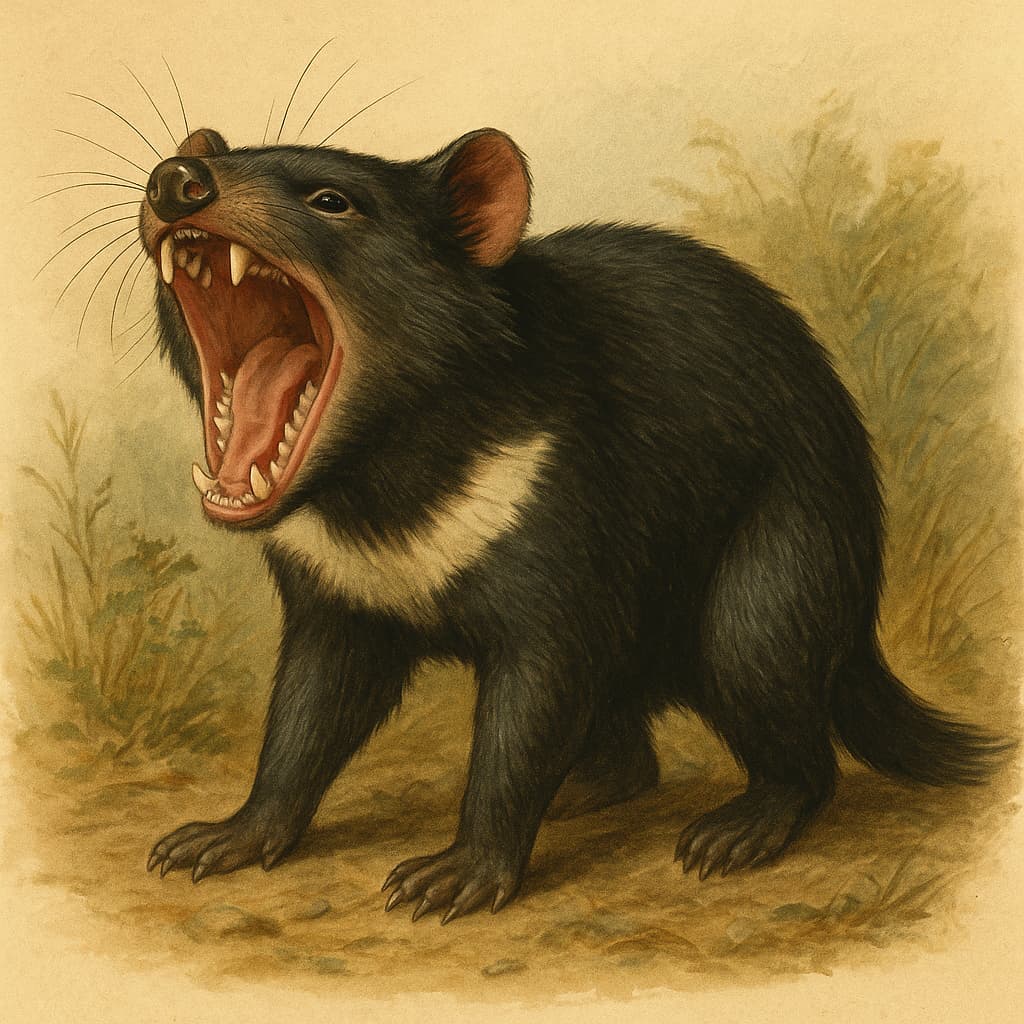
So sad. I love these foul-tempered little critters. They're just as funny in real life as Taz in Looney Toons. The original article I based this post on no longer exists, so I asked ChatGPT to create a blog post for me. It think it did a pretty good job -- read on:
The Tasmanian devil (Sarcophilus harrisii) is a unique and iconic marsupial — the world’s largest surviving carnivorous marsupial — found only in Tasmania, Australia. Once abundant, these fierce, nocturnal scavengers now teeter on the brink of collapse.
Over recent decades, scientists and conservationists have raised the alarm: the Tasmanian devil may be facing possible extinction in the wild. This blog post delves into the forces driving that threat, the countermeasures underway, and whether extinction is inevitable — or avoidable.
What’s Driving the Decline?
1. Devil Facial Tumour Disease (DFTD) — A Deadly, Contagious Cancer
The greatest existential threat to Tasmanian devils is Devil Facial Tumour Disease (DFTD) — a rare kind of transmissible cancer.
- DFTD first emerged around 1996 and has since decimated devil populations, contributing to an ~80 % decline in many areas.
- The disease is spread via biting — a common behavior among devils during mating, feeding, and dominance contests.
- Once infected, devils typically succumb within months, as tumors interfere with eating and general health.
- There are now two known forms: DFT1 and DFT2, both transmitted similarly.
Because the disease is so virulent and nearly universally fatal, it’s not just a disease but an existential threat.
2. Low Genetic Diversity & Historical Declines
Even before DFTD arrived, Tasmanian devils had experienced population bottlenecks, human hunting, and habitat alteration. Those historical pressures left the species with relatively low genetic diversity and limited adaptive capacity.
Low genetic variability means fewer “immune system tricks” in the gene pool, reducing the odds that devils might evolve resistance to DFTD quickly.
3. Synergistic Pressures: Roads, Habitat Change, Diet Shifts
DFTD isn’t acting in isolation. Several other threats amplify its effect:
- Road kill: As wild populations shrink, road mortality becomes a more significant cause of death, especially when devils scavenge roadkill.
- Habitat alteration and human-modified landscapes: Devils in human-impacted zones often have more restricted diets (fewer prey options) and are forced into ecological traps.
- Ecological shifts & climate pressures: Some modeling suggests past climate changes may have stressed devil populations, and future climate variation could exacerbate resource limitations.
Together, these pressures reduce population resilience, making the species more vulnerable to collapse from DFTD.
Is Extinction Inevitable?
The short answer: not necessarily — but it’s a real risk. The situation is dire, and many early models did forecast extinction, but more nuanced simulations and field evidence suggest a more complex picture.
- Some spatial metapopulation models show that although devil densities may collapse to ~9% of their original levels, coexistence with DFTD is possible through reinvasion dynamics: patches where local populations go extinct may eventually be recolonized from neighboring patches.
- That said, models also indicate that the devils’ long-term persistence will be precarious and require interventions to prevent total collapse.
- Some researchers had optimism when a study in 2020 suggested that transmission rates of DFTD had decreased — possibly as devils developed resistance. But subsequent critiques (e.g. by Cambridge researchers) challenged that interpretation, raising concerns about methodological robustness.
- Even in areas heavily impacted by DFTD, wild devil populations are still found, and there is no confirmed total extinction in any region yet.
So extinction is not inevitable — but the margin of safety is narrow.
Conservation Efforts & Rays of Hope
Despite the challenge, a wide array of conservation strategies are underway. Many are innovative and ambitious. Here are some of the key efforts:
Insurance Populations & Captive Breeding
- The “insurance metapopulation” concept means keeping populations in captivity (or in disease-free zones) as backup against wild population collapse.
- Remarkably, genetic studies suggest that these insurance populations are as genetically diverse as wild ones, supporting their viability for reintroduction.
- The Save the Tasmanian Devil Program (STDP) is a central Australian/Tasmanian government initiative set up in 2003 to coordinate conservation, monitoring, captive breeding, disease control, and reintroduction.
Island & Disease-Free Sanctuaries
- Devils have been translocated to isolated islands like Maria Island to establish disease-free populations.
- In Tasmania, certain regions are maintained as disease-free zones with strict biosecurity, and devils are slowly reintroduced there.
- Fencing, barrier zones, and monitoring are used to prevent DFTD spread into uninfected areas (e.g. on the Tasman Peninsula).
Disease Research & Vaccine Development
- Because DFTD is a transmissible cancer (unlike typical cancers), scientists are investigating unique strategies to block transmission, stimulate immune response, and induce tumor regression.
- Promising research includes experiments with potential vaccines, immunotherapies, and selective breeding for resistance.
- A recent news report (2024) noted that researchers are preparing trials of a “bait vaccine” for devils, with hopes that a field-ready version might emerge in a few years.
Monitoring, Modeling & Data Science
- Conservationists are using advanced computer models (e.g., particle filters) to predict disease spread, project population outcomes, and plan interventions.
- Long-term monitoring of devil densities, demographics, and disease prevalence is vital.
- Integrating genomic, physiological, and ecological data helps scientists understand which devils might resist disease and how populations could adapt.
Community Engagement & Public Awareness
- Zoos, parks, and conservation NGOs help raise public awareness, fundraise, and host captive devils for education.
- Partnerships like Aussie Ark are working to reintroduce devils to mainland Australia (in protected reserves) as a diversification strategy.
- Roadkill mitigation efforts, planning for wildlife corridors, and controlling human-devil conflict also form part of the broader strategy.
Challenges & Uncertainties
Even the best efforts face daunting obstacles:
- Disease evolution: DFTD could evolve to become more transmissible or circumvent any vaccine or resistance that emerges.
- Rapid adaptation needed: Devils may need to evolve resistance or behavioral changes fast — faster than typical for mammals — to survive in the wild.
- Fragmented habitat & isolation: Loss of connectivity could prevent recolonization of extinct patches.
- Funding & political will: Conservation is resource-intensive and often competes with many other priorities.
- False optimism: Some recent research (notably the 2020 study on declining transmission) has been challenged, reminding us how uncertain projections can be.
- Extinction debt: Even if immediate extinction is avoided, the species may carry a long-term risk due to low numbers, inbreeding, and ecological disruption.
What the Future Might Look Like
If the devil goes extinct in the wild, the consequences will ripple through Tasmania’s ecosystems. Devils are apex scavengers and predators of small mammals, helping control populations of prey and competing scavengers. Their absence would alter food webs significantly.
But there is still reason for cautious hope:
- If vaccine trials succeed and immunity becomes widespread, wild populations could rebound — especially with continued support and reintroductions.
- Insurance populations serve as a safeguard against total extinction — even if wild populations collapse, the species isn’t lost altogether.
- Adaptive management (i.e. dynamic reintroduction, genetic monitoring, disease control) gives conservationists levers to respond in real time.
- The evolutionary “arms race” may favor some devil lineages that evolve resistance, expanding their share of survival.
In the best scenario, the devil persists in a lower but sustainable equilibrium with DFTD, bolstered by human intervention.
Conclusion: On the Brink, but Not Beyond Saving
The Tasmanian devil is perhaps one of the best illustrations of modern conservation’s precarious balancing act: a species nearly knocked to its knees by disease, historical pressure, and environmental change — yet not yet vanquished.
Extinction in the wild is a realistic possibility if conservation efforts wane or fail, especially given disease’s relentless onslaught. But the mixture of captive breeding, targeted reintroduction, genomic research, and vaccine trials creates a lifeline no earlier generation of devils had.
For now, the species survives by a thread. Whether that thread holds will depend not just on science, but on sustained commitment, funding, and ecological vigilance.