
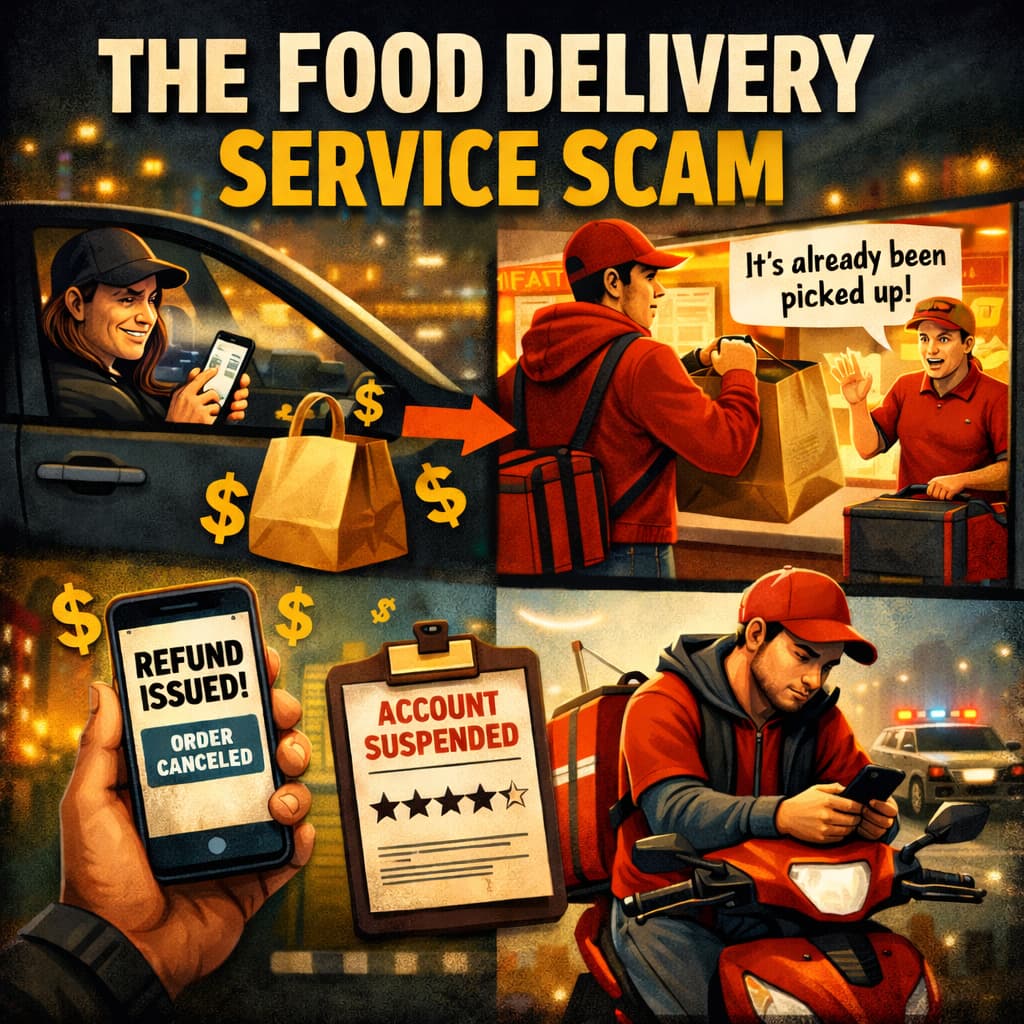
Thieves are regularly exploiting food delivery services, restaurants, and delivery drivers using a simple but effective tactic:
- A thief places an order through a food delivery app while sitting in their car outside a fast-serve restaurant.
- The thief walks into the restaurant and asks for the order.
- The restaurant fails to verify that the person is an actual delivery driver.
- The restaurant hands the order to the thief, who leaves with the food.
- The real delivery driver assigned to the order arrives to pick it up.
- After some confusion or delay, the restaurant informs the driver that the order has already been collected.
- The driver marks the order as “already picked up by someone else” and leaves.
- The thief reports to the delivery service that the food never arrived and receives a refund.
- The restaurant is charged back for the order because it was never marked as picked up in the system.
- The delivery driver may be reprimanded for failing to complete the delivery. Moreover, the delivery driver has wasted precious time and fuel attempting to do their job -- money lost that cannot be recovered.
In some cases, the actual driver arrives while the thief is still waiting for the food. When this happens, the thief may say something like, “I’m just going to get my own food.” The driver has little choice but to leave and attempt to report the incident.
Unfortunately, delivery services provide poor support for drivers in these situations. Reporting an incident is often difficult, time-consuming, and rarely leads to a meaningful resolution. Experienced drivers usually walk away and simply avoid that restaurant in the future.
Thieves tend to target restaurants that prepare orders very quickly—places like Panda Express—where staff are under pressure and less likely to verify pickup credentials. Locally owned restaurants often catch on quickly because they actively monitor chargebacks. Large national chains, however, frequently have disengaged staff who don’t see the financial impact and therefore don’t intervene.
The risk to the thief is minimal. Police generally won’t pursue arrests for stolen food, and delivery services rarely report these incidents to authorities. At worst, a thief might lose their delivery account—but they can easily open a new one using a different debit card.
After repeated claims of non-delivery, delivery companies sometimes require a PIN to complete a delivery. Aggressive thieves will then attempt to bully or manipulate the driver by refusing to provide the PIN, not answering the door, or harassing the driver in hopes the food will be left unattended.
If the thief does provide the PIN and the delivery is completed properly, retaliation often follows in the form of a very poor driver rating—for the crime of not helping them steal food.
What Restaurants Can Do
Restaurants are not powerless in this situation, but preventing theft requires small changes that staff must consistently follow:
- Verify pickup credentials. Drivers should be required to show the order on their phone and confirm the customer name or order number before food is handed over.
- Require drivers to mark orders as “picked up.” Many restaurants already ask this, but enforcement is often lax. Watching the driver tap “picked up” in the app prevents most scams.
- Keep delivery orders behind the counter. Unattended pickup shelves make theft effortless.
- Train staff on common scams. Once employees recognize the pattern, theft drops quickly.
- Track repeat incidents. Chargebacks are a clear signal something is wrong, and patterns often point to specific time windows or order types.
Independent restaurants tend to adopt these measures quickly because stolen food directly affects their bottom line. Large chains often do not—until losses become impossible to ignore.
Why Delivery Platforms Enable This
Food delivery platforms unintentionally enable this behavior through a combination of design choices and incentives:
- Speed is prioritized over verification. Platforms reward fast handoffs and high order volume, not careful confirmation.
- Restaurants are treated as interchangeable. Losses are absorbed as a cost of doing business rather than as criminal activity.
- Driver support is intentionally limited. Making incident reporting difficult discourages claims and reduces platform overhead.
- Customer complaints are default-trusted. Issuing refunds is cheaper than investigating fraud.
- Account creation is too easy. Losing an account carries little consequence when new ones can be created quickly.
The system works—until it doesn’t. Theft becomes normalized, honest drivers are penalized, restaurants absorb losses, and the platforms quietly write it all off as friction in the algorithm.